

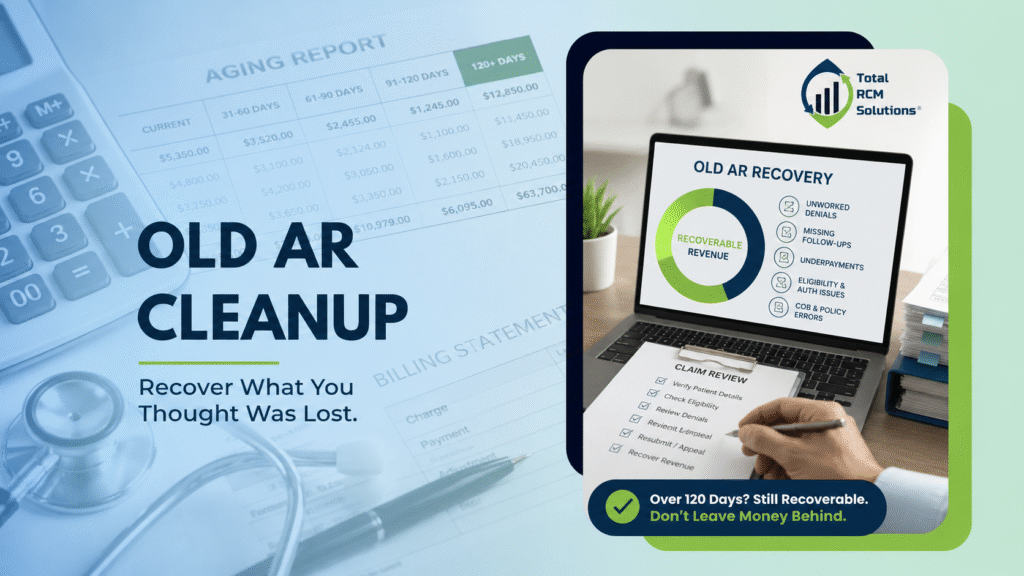
In healthcare revenue cycle management, aging claims are often viewed as “dead AR.” Once claims cross 120 days, many practices stop prioritizing them and shift focus to newer balances. Unfortunately, that mindset can leave thousands — sometimes millions — of dollars uncollected.
The truth is: old AR is not always lost revenue.
At Total RCM Solutions, we’ve seen practices recover significant payments from claims that were sitting untouched for months. The key is understanding why claims aged in the first place and having a dedicated strategy to work them correctly.
Why Claims Age Beyond 120 Days
Old AR usually builds up gradually. In many cases, it’s not caused by one major issue — it’s the result of small gaps piling up over time.
Some of the most common reasons include:
- Unworked denials
- Missing claim follow-ups
- Eligibility or authorization issues
- Incorrect payer routing
- Underpayments
- Lack of appeal tracking
- Staffing shortages
- High turnover in billing teams
- Claims falling through the cracks during EMR transitions
Once claims move past 90–120 days, they require more specialized attention and payer-specific follow-up strategies.
The Biggest Misconception About Old AR – “If the claim is old, the payer won’t pay.”
That’s not always true.
While timely filing limits are important, many aging claims still have recovery opportunities through:
- Corrected claim submissions
- Reconsiderations
- Appeals
- Secondary insurance billing
- Reprocessed denials
- Documentation resubmission
- Payment variance reviews
We often find claims that were:
- denied incorrectly,
- partially paid,
- never followed up,
- or simply left unresolved.
Why Old AR Cleanup Requires a Dedicated Team
Old AR cannot be managed effectively as a side task.
Most billing teams are already focused on:
- daily claim submission,
- payment posting,
- patient calls,
- and current denials.
As a result, aging claims continue getting pushed further back.
That’s why successful AR recovery usually requires:
- dedicated resources,
- structured workflows,
- payer escalation knowledge,
- and aggressive follow-up.
At Total RCM Solutions, our AR specialists focus specifically on identifying recoverable balances and prioritizing claims with the highest recovery potential.
What Practices Should Review in Their Aging AR
If your practice has AR over 120 days, here are some areas worth reviewing:
- Claims with no follow-up activity
- High-dollar unresolved balances
- Medicare Advantage denials
- Claims pending medical records
- Coordination of Benefits (COB) issues
- Incorrect patient demographics
- Underpaid claims
- Appeals never resubmitted
- Secondary claims never billed
Even small recovery improvements can create a major impact on cash flow.
The Financial Impact of Ignoring Old AR
Ignoring old AR doesn’t just affect revenue — it affects operational stability.
Practices dealing with aging AR often experience:
- cash flow pressure,
- increased write-offs,
- delayed provider payments,
- staffing strain,
- and reduced operational flexibility.
Recovering even a portion of old balances can significantly improve financial health without increasing patient volume.
Final Thoughts
Old AR may be aging but that doesn’t mean it’s unrecoverable.
The longer claims sit untouched, the harder recovery becomes. However, with the right follow-up strategy, experienced AR resources, and payer knowledge, many practices can still recover meaningful revenue from claims over 120 days old.
At Total RCM Solutions, we help practices identify hidden recovery opportunities, work aging balances aggressively, and reduce long-standing AR backlogs so providers can focus on patient care instead of unpaid claims.
If your practice is struggling with old AR, now is the time to review what may still be collectible.