

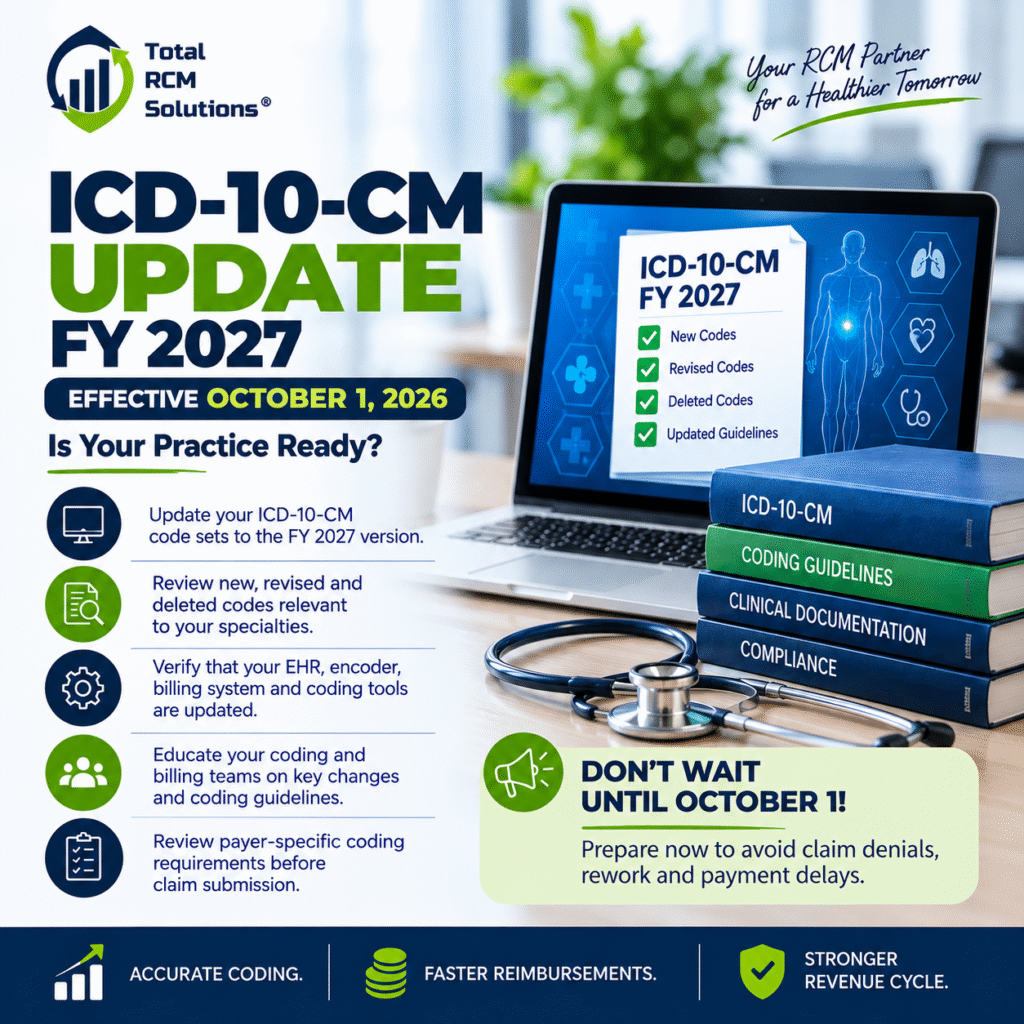
Effective October 1, 2026
The annual ICD-10-CM update is an important date on the U.S. healthcare revenue cycle calendar. Beginning October 1, 2026, healthcare organizations must use the FY 2027 ICD-10-CM diagnosis codes for applicable patient encounters.
The Centers for Medicare & Medicaid Services (CMS) and the Centers for Disease Control and Prevention (CDC) have released the FY 2027 ICD-10-CM files, including updated code tables, the Index, addenda, conversion table, and official coding guidelines. The FY 2027 codes apply to healthcare services provided from October 1, 2026 through September 30, 2027.
For medical practices, this isn’t simply a coding-system update. Changes to diagnosis codes can affect documentation, claim submission, medical necessity, payer processing, coding accuracy, and ultimately the revenue cycle.
What Is Changing With the FY 2027 ICD-10-CM Update?
Each annual ICD-10-CM release can include changes such as:
- New diagnosis codes
- Revised code descriptions
- Deleted or invalidated codes
- Changes to coding guidance
- Updates to the Tabular List and Alphabetic Index
- Changes that may affect specialty-specific coding workflows
CMS has made the FY 2027 ICD-10-CM code files and coding guidelines available for implementation.
The FY 2027 Official Guidelines for Coding and Reporting are also available and should be incorporated into coding education and workflow updates.
Why Does This Matter to the Revenue Cycle?
Diagnosis coding plays an important role in communicating the patient’s documented condition and supporting the services reported on a claim.
When outdated, deleted, or incorrect diagnosis codes continue to be used after an update, billing teams may encounter claim processing issues, additional rework, payment delays, or other reimbursement challenges.
That is why ICD-10-CM preparation should involve more than simply uploading a new code file.
It should be treated as a revenue cycle readiness exercise.
5 Steps Your Practice Should Take Before October 1
1. Update Your ICD-10-CM Code Set
Confirm that your EHR, encoder, practice management system, billing platform, and other coding resources are prepared to use the FY 2027 code set.
CMS identifies the FY 2027 ICD-10-CM files for patient encounters from October 1, 2026 through September 30, 2027.
2. Review New, Revised, and Deleted Codes
Don’t assume every change applies equally to every practice.
Your coding team should identify the changes relevant to your specialties, providers, diagnoses, and frequently reported services.
A focused review can help teams understand which codes need to be added, replaced, or removed from their day-to-day workflows.
3. Review the FY 2027 Coding Guidelines
Code changes should be reviewed alongside the official coding guidelines.
The FY 2027 guidelines provide instructions covering multiple coding areas, including changes and guidance across the ICD-10-CM chapters.
Coding teams should incorporate applicable updates into their education and internal coding references.
4. Check Your Technology and Workflows
Updating the code set in one system may not be enough.
Practices should verify that applicable updates are reflected across:
- EHR systems
- Encoders
- Practice management systems
- Clearinghouse workflows
- Coding reference tools
- Charge capture processes
- Billing workflows
A technology update should also be tested before the first October claims are submitted.
5. Educate Your Coding and Billing Teams
Even when systems are updated correctly, staff need to understand what has changed.
Consider providing your coding and billing teams with:
- Specialty-specific code change summaries
- Coding guideline updates
- Examples of commonly affected diagnoses
- Internal coding references
- Pre-submission quality checks
This can help create a smoother transition when the new code set becomes effective.
Don’t Forget Payer-Specific Requirements
ICD-10-CM codes are part of a larger claim.
Depending on the payer and service, diagnosis coding may interact with medical necessity requirements, coverage policies, claim edits, and other billing requirements.
CMS also publishes coding-related updates affecting Medicare policies and National Coverage Determinations. For example, CMS’s October 2026 update includes revisions involving ICD-10 diagnosis codes associated with certain NCDs.
Therefore, practices should review applicable payer guidance in addition to the standard ICD-10-CM update.
What Should RCM Teams Monitor After October 1?
The transition shouldn’t end when the new code set goes live.
Revenue cycle teams can monitor:
Denials and rejections
Look for increases associated with diagnosis coding or claim edits.
Coding-related rework
Identify recurring coding corrections and their underlying causes.
Claim acceptance trends
Compare pre- and post-update claim processing patterns.
Payment delays
Watch for unusual changes in reimbursement timing.
Provider documentation issues
Identify documentation patterns that make accurate code assignment difficult.
This type of monitoring can help distinguish isolated issues from recurring workflow problems.
ICD-10-CM Update: A Coding Change With Revenue Cycle Impact
For healthcare organizations, ICD-10-CM updates shouldn’t be viewed as a once-a-year coding task.
Accurate diagnosis coding connects clinical documentation, coding, billing, payer processing, and reimbursement.
Preparing ahead of October 1 gives practices an opportunity to review their systems, educate their teams, identify specialty-specific changes, and monitor claims once the new code set goes live.
Is Your Practice Ready for FY 2027?
The FY 2027 ICD-10-CM code set becomes effective October 1, 2026. CMS has already made the updated files available, and CDC confirms that the FY 2027 release replaces the FY 2026 April 1 release for services beginning October 1.
At Total RCM Solutions, we help healthcare organizations strengthen their revenue cycle through accurate coding, billing, claims management, denial management, A/R follow-up, and performance analysis.
Prepare your team. Update your systems. Review your coding. Protect your revenue.
Total RCM Solutions
Your RCM Partner for a Healthier Tomorrow.
#ICD10CM #MedicalCoding #MedicalBilling #RevenueCycleManagement #HealthcareRCM #HealthcareCompliance #CMSUpdates #HealthcareRevenue